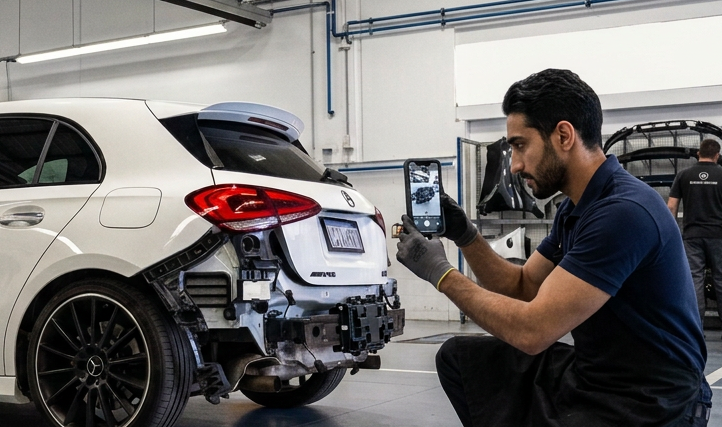
You’re the owner. You’re the manager. You know the exact moment the day derails. It’s 10:30 AM. A key technician walks in from the tear-down bay, holds up a mangled, unidentifiable plastic bracket, and says, “This wasn’t on the initial estimate, and the supplier says they don’t know what it is or if it’s available.”
You know what follows. The tear-down stops. The bay is locked up, occupying prime real estate in your shop. Your office staff is now playing phone tag with three different parts counters, sending emails with photos, and trying to describe a complex trim piece. The cycle time clocks down. And your profit margin on that job just took a n dive.
This is the “collision parts black hole”—the chaos between the estimate and the final assembly—and it’s swallowing your efficiency and your profit.
We’ve all got Body Shop Management Systems (BMS). We’ve all got parts procurement portals (like OEConnection, Partslink, Partscheck, or others). We’ve been told they are “integrated.” But true, intelligent integration—the kind that predicts and prevents problems rather than just flagging them—is the next level. And that level is achieved through intelligent AI connected with parts procurement.
Here is the straightforward business case for why your BMS and your parts procurement need to be supercharged with an embedded AI parts procurement tool.
The Death of the Disconnected Supplement
Right now, your supplement process is likely a massive friction point. A tech performs R&I (Remove and Install) or further tear-down, finds hidden damage (e.g., a cracked secondary radiator support or a variant in a wiring loom), and you add it to the BMS estimate.
The problem is the gap. The estimator adds the line, but then a different process begins to actually source the part. This often involves manually re-entering data into a procurement portal or calling a parts counter. This gap—this movement from the BMS estimate to the procurement action—is where transcription errors, model year variances, and trim level mistakes are born.
Next-level AI integration closes that gap permanently. When hidden damage is identified (often supported by a digital photo of the damaged area), intelligent systems work directly within your BMS. The AI doesn’t just display a generalized catalogue; it uses the vehicle’s specific VIN (decoded down to the smallest variance, build date, and option code) to actively identify and verify the correct, VIN-accurate part number.
The AI confirms the fitment and updates the estimate simultaneously, completely removing the manual re-entry that causes ordering errors.
Workflow Predictability: Maximizing Bay Utilization
As a manager or owner, you know that profitability in collision repair is about bay utilisation and throughput. Every hour a vehicle sits in a bay waiting for a corrected part is an hour you are losing money in that bay and that technician.
When parts identification is 100% accurate (via VIN-verified AI) and availability is checked in real-time, the supplement process shifts from reactive chaos to predictive scheduling. When you order the supplement part, you know it’s the right one, and you know when it will arrive.
This level of certainty means you can schedule your technicians and bays with precision. It eradicates the scenario where a vehicle has to be assembled and disassembled twice because of a parts error, or where a car is moved out of the shop and back into storage, killing your key-to-key time.
The Bottom Line: True Collision Efficiency
The supplement process is inevitable in collision repair, but the associated disruption is not. Continuing to rely on “good enough” integration—the manual bridging of systems—is costing you money every single day. If your Bodyshop system isnt connecting to a system that can provide this, then ask yourself the question WHY? Consider the alternatives and find ones that do because it could be the game changer they want you to not know about.
The technology exists right now to move beyond the friction of manual lookup. It’s about leveraging targeted, embedded intelligence that speaks the same language as your BMS and your suppliers’ inventory. It’s about turning parts procurement into a competitive advantage that ensures the right parts arrive, the first time, keeping your bays moving and your shop profitable.