Beyond the Parts Manual: How Digital Imaging and Connected AI Are Killing Supplement Mistakes
Let’s be direct. Supplements are the primary bottleneck in modern collision repair. They stall production, drown your admin staff in paperwork, and turn relationships with suppliers into a source of constant friction. The core issue isn’t discovering the hidden damage; it’s the tedious, error-prone scramble to identify and order the correct parts that follow.
We’ve accepted “making calls,” “checking the diagram,” and “hoping it fits” as standard procedures for decades. But the complexity of modern vehicles, combined with the pressure for faster cycle times, means that manual, fragmented processes are no longer viable. They are financial drains.
The answer isn’t a better parts catalogue on your computer. It’s Smarter Supplements: the convergence of high-resolution digital imaging with advanced, connected Artificial Intelligence (AI).
This isn’t sci-fi; it’s the next critical phase in digitizing the supplement workflow. Here’s how these forward thinking technologies are actively eliminating the errors that strangle repair efficiency:
The Death of Guesswork: AI Analyzing the Actual Damage
Traditionally, a technician identifies a damaged part, estimates the replacement, and then looks up a part number from a diagram that might (or might not) perfectly match that trim level. This process involves a massive leap of faith—interpreting a schematic and applying it to reality. This is where “bad data in” starts.
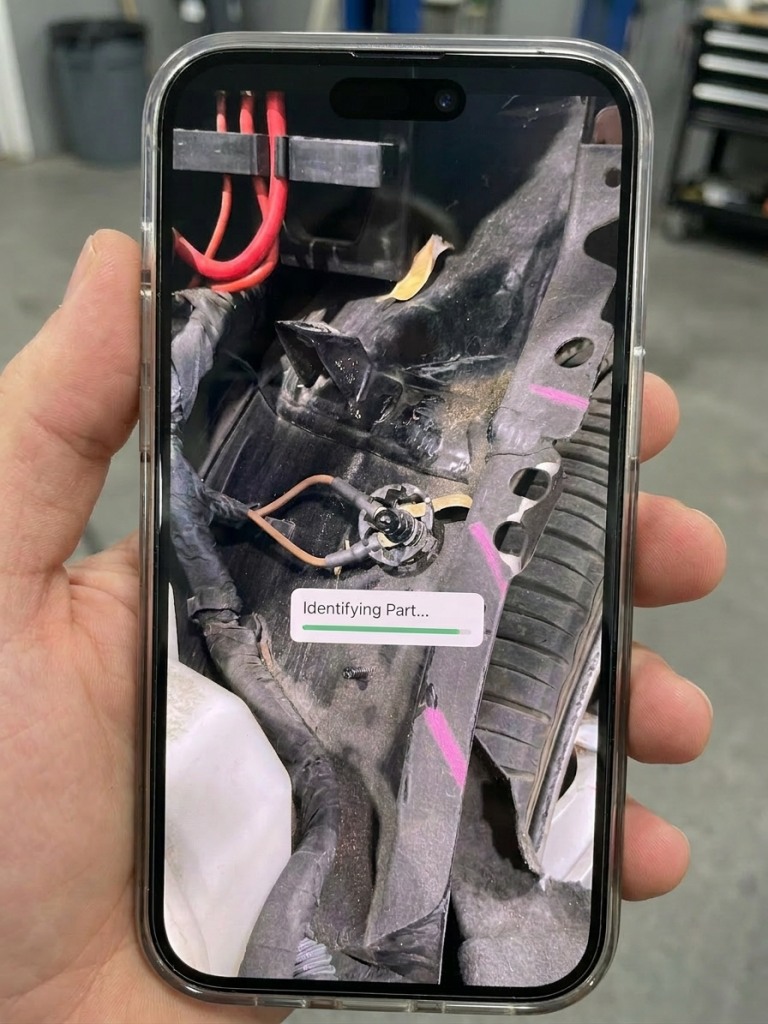
The new approach flips the process. Instead of guessing based on a diagram, the technician uses digital imaging—a simple smartphone or shop tablet—to capture images of the specific damaged part, in situ and after removal. These aren’t just snapshots for the insurer; they are critical data points for the parts identification process.
Connected AI systems are trained on datasets containing hundreds of thousands of vehicle diagrams, assembly layouts, and, crucially, images of the parts themselves. When the technician snaps that photo, the AI analyzes the visual cues: shape, connection points, surface topography, and location within the assembly.
It doesn’t just show a door assembly; it identifies the precise part in the picture. The AI confirms, for example, “This is the primary impactsensor, specifically for this corner of the vehicle.” It connects the visual evidence directly to the OEM’s master database.
Live, Hyper-Accurate Fitment: Cross-Referencing the Visual with the VIN
Visual identification alone is powerful, but modern vehicle variations (build dates, trim packages, drivetrain options) still pose a fitment risk. The AI doesn’t just guess “that looks like a sensor for a Ford Ranger.”
It takes that specific visual ID and instantaneously cross-references it against the vehicle’s specific Vehicle Identification Number (VIN). The system decodes that VIN down to the absolute smallest build variance. The AI doesn’t just display a list of possible sensors; it runs an automated, connected fitment check in the background.
The platform actively verifies that the sensor identified in the image is not only a sensor, but the sensor—the single, definitive, VIN-accurate match for that individual vehicle and that specific option package. This integration of digital imagery (the what) with the VIN decode (the exactly which one) eliminates the “looks about right” guesswork entirely.
The Digital Handshake: From Verified Part to Supplier Order
The breakdown in the ordering chain usually happens between the shop and the parts counter. Transcribing numbers, emailing diagrams, or trying to describe a bracket over the phone are inefficient. Mistakes are guaranteed.
Integrated digital platforms, leveraging this AI and imaging, replace these broken steps with a seamless digital handshake. Once a part is visually verified and VIN-checked through the intelligent system, the ordering data is generated automatically.
This data—containing the exact, verified part number and the specific vehicle context—is pushed directly from the estimating system with an integrated Partssearch account.
There is no manual translation, no phone tag, and no interpretation needed. The supplier receives an order that is, by definition, 100% accurate for the job. This removes the risk of transcription errors and ensures the supplier knows exactly what to pull.
Impact: The End of the “Parts Ordering Lottery”
This convergence of digital imaging and connected AI isn’t an efficiency improvement; it’s a re-engineering of the entire supplement process. The benefits are dramatic:
For the Shop: predictable Workflow & Reduced Cycle Times
The immediate impact is workflow stability. Eliminating parts ordering errors means vehicles are not occupying hoists or bays waiting for replacement for parts that were ordered incorrectly. Production flow becomes predictable. Key-to-key times improve drastically. Administrative time spent managing returns and resolving vendor conflicts disappears, allowing staff to focus on production and quality. Look at emerging AI connected Bodyshop management software like Repair-shop.com.auFor the Supplier: Eliminating the Friction (and Cost) of Returns
Suppliers operating with these intelligent, visual-driven partners gain massive efficiencies. Fulfillment accuracy spikes. Inventory management is streamlined. The single greatest financial benefit, however, is the near-elimination of the costly parts return cycle. Dealing with accurate, pre-verified visual orders reduces operating costs and allows suppliers to focus on being a trusted partner, not just a logistics manager for mistakes.
The supplement process is necessary, but the error rate associated with it is a relic of the past. The industry is rapidly moving towards a digital standard where high-resolution imaging and connected AI are the new eyes and brain of the parts process. It’s time to stop gambling on the parts order and start leveraging the precise power of visual intelligence.