Stop Losing Money on Variations: How to Train Veteran Techs for AI Supplementary Parts Identification
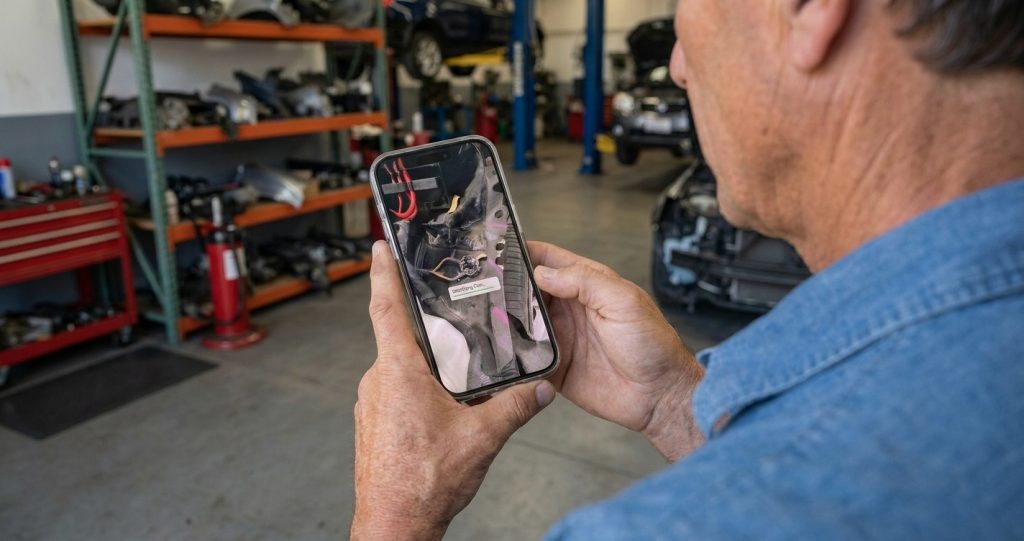
Walk into the strip-and-fit bay of any smash repair shop in Australia, and you’ll see the exact same scene.
A damaged bumper bar comes off. The broken inner plastics, snapped headlamp lugs, and crushed brackets are tossed onto a workshop trolley or into the boot. A panel beater snaps a quick, wide photo of the messy pile on their tablet and moves on to the next job.
For the last 20 years, that single photo was enough. An experienced estimator or an insurance assessor could look at that pile of black plastic and know exactly what needed to be ordered.
But as the Australian collision industry moves to AI-driven estimating, that “parts pile” photo has become a massive liability.
When you feed a photo of a cluttered trolley to an AI algorithm, it doesn’t see individual parts. It sees a dark, unidentifiable blob. The result? The AI misses the supplementary parts, the initial quote is short, variations are delayed, and the car sits in your bay for an extra week waiting for a $40 bracket.
If you want to stop losing money on variations and build perfectly accurate parts lists from the get-go, you need to change how your workshop floor operates. Here is a simple, easy-to-read guide to retraining your veteran techs for AI parts identification.
The Big Shift: Assessors vs. Algorithms
You have to explain to your team why they are changing their habits.
Veterans aren’t being stubborn; they just know their old photos worked fine for human assessors. You need to explain that human assessors have common sense—AI does not. AI algorithms rely on clear outlines, edges, and text to identify an object.
To get your team on board, introduce these Four Golden Rules for AI Parts Capture:
Rule 1: Kill the “Parts Pile”
AI cannot separate objects that are stacked on top of each other. If a broken fog light bezel is sitting on top of a crushed radiator support, the AI gets confused.
- The Fix: Introduce the Isolate & Identify rule. Tell your strip-and-fit techs to hold the broken part up against a plain background (like the concrete floor, a piece of cardboard, or their shirt) so the AI can clearly see the edges of the part.
Rule 2: Hunt for the Sticker
Your staff hate administrative work. They hate manually writing down 17-character VINs or typing out 12-digit OEM part codes. Use this to your advantage.
- The Fix: Modern AI uses Optical Character Recognition (OCR) to read text in photos. Tell your team: “Don’t just photograph the broken plastic. Find the stamped part number, the QR code, or the OEM sticker and get a clear, glare-free close-up.” When the AI reads that sticker, it automatically drops the exact part into the ordering cart. No manual typing required.
Rule 3: The Barcode Scanner Rule
When a veteran complains about having to hold the camera a certain way, give them an analogy they understand immediately.
- The Fix: Tell them to treat the workshop tablet like a barcode scanner at Bunnings or Woolies. You can’t just wave a product vaguely near the scanner and expect it to beep. You have to line it up perfectly. Taking a photo for AI is the exact same thing: You are scanning the broken part into the database.
Rule 4: Make the Veteran the “Boss” of the AI
The quickest way to get a veteran panel beater to reject AI is to make them feel like a machine is taking their job. Flip the script.
- The Fix: Remind them that an AI cannot unbolt a front guard. It doesn’t know that a heavy front impact likely snapped a hidden wiring harness. Only your experienced tech knows that. Tell them: “The AI is your apprentice. You expose the damage, scan the parts, and let it build the bulky parts list. Then, you review its work to make sure it didn’t miss anything.”
The Workshop Wall “Cheat Sheet”
Print this out and stick it in your tear-down bays to keep the standard high:
📸 The AI Parts Photo Checklist:
- Isolate it: Pull the broken part away from the clutter. No “parts pile” photos!
- Clean the lens: A greasy fingerprint on the tablet camera ruins the AI’s vision.
- Find the numbers: Always take a clear, close-up shot of the OEM sticker or stamped part number.
- Watch the glare: Don’t use a harsh flash on glossy stickers; it creates a blind spot for the AI.
- Capture the connection: If a wire or sensor is broken, show where it connects to the main structure.
The Bottom Line
AI technology is the ultimate tool for killing the bottleneck of supplementary parts ordering. But the software is only as good as the data your boys on the floor feed it.
By eliminating the messy parts pile, focusing on OEM stickers, and elevating your veteran techs to act as the AI’s supervisor, you will catch more damage upfront, get variations approved faster, and keep cars moving efficiently through your shop.